
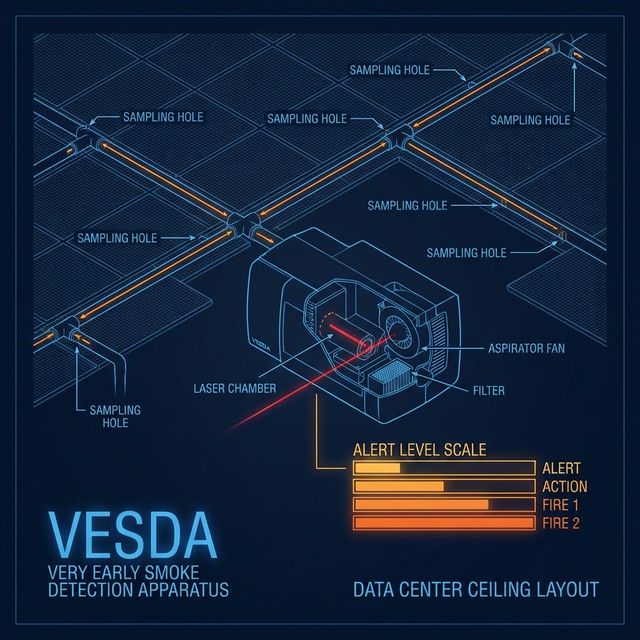
Understanding Very Early Smoke Detection Apparatus (VESDA), how it works, and where ultra-early fire detection is essential.
VESDA (Very Early Smoke Detection Apparatus) is an advanced air-sampling smoke detection system designed to detect fire at its earliest stage — even before visible smoke appears.
Unlike traditional detectors, VESDA continuously samples air through a network of pipes and analyzes it for microscopic smoke particles.
**How VESDA Works**
- Air is drawn through sampling pipes
- Air passes through laser detection chamber
- Particle concentration is measured
- System generates multi-level alerts
Alert Levels:
- Alert
- Action
- Fire 1
- Fire 2
This allows preventive response before fire escalation.
**Where VESDA is Required**
- Data centers
- Server rooms
- Telecom facilities
- Clean rooms
- Control rooms
- High-value storage areas
- Airports and command centers
**Advantages**
- Ultra-early detection
- Reduced downtime risk
- Prevents equipment damage
- Suitable for high-airflow environments
**When Standard Detectors Are Not Enough**
In mission-critical environments where even minor smoke can cause major loss, VESDA becomes essential.
Unlike traditional detectors, VESDA continuously samples air through a network of pipes and analyzes it for microscopic smoke particles.
**How VESDA Works**
- Air is drawn through sampling pipes
- Air passes through laser detection chamber
- Particle concentration is measured
- System generates multi-level alerts
Alert Levels:
- Alert
- Action
- Fire 1
- Fire 2
This allows preventive response before fire escalation.
**Where VESDA is Required**
- Data centers
- Server rooms
- Telecom facilities
- Clean rooms
- Control rooms
- High-value storage areas
- Airports and command centers
**Advantages**
- Ultra-early detection
- Reduced downtime risk
- Prevents equipment damage
- Suitable for high-airflow environments
**When Standard Detectors Are Not Enough**
In mission-critical environments where even minor smoke can cause major loss, VESDA becomes essential.